“Joint lines are often the biggest barrier to achieving truly premium interiors. Today, ultra-large-format slabs are changing how architects design expansive commercial spaces.”
1200×2400 mm porcelain slabs are redefining how architects design expansive commercial spaces. Joint lines are often the biggest barrier to achieving truly premium interiors. Today, ultra-large-format slabs are changing how architects approach large-scale commercial projects.

Who This Shift Matters To
This transition towards ultra-large slabs is especially relevant for:
- Architects designing large public and corporate spaces
- Project consultants and PMCs handling high-footfall developments
- Commercial developers planning long-term asset value
- Facility planners focused on maintenance and hygiene
For these stakeholders, fewer grout lines mean fewer compromises.
Eliminating Grout Lines with 1200×2400 mm Porcelain Slabs
Traditional tile formats often interrupt large surfaces with visible grout lines. In expansive areas such as airports, malls, hotels, and corporate lobbies, this breaks visual continuity and reduces the premium feel of the space.
With 1200×2400 mm slabs, the surface appears cleaner, broader, and more uniform. The reduced number of joints creates a seamless visual flow that aligns perfectly with modern commercial architecture, where scale and simplicity matter.

Why 1200×2400 mm Porcelain Slabs Make Sense for Large Commercial Projects
The appeal of ultra-large slabs goes beyond aesthetics.
- Fewer joints reduce visual clutter and installation errors
- Lower grout usage improves hygiene and simplifies cleaning
- Larger surface coverage enhances design consistency across wide areas
Architects prefer 1200×2400 mm porcelain slabs in large commercial projects because they reduce visual joints while maintaining durability and design consistency.
For commercial projects with thousands of square feet to cover, these advantages translate into better execution and long-term usability.

Maintenance Benefits of 1200×2400 mm Porcelain Slabs
Reduced grout lines help meet modern commercial hygiene expectations, as highlighted in global architectural material standards by ArchDaily.
Grout lines are often the first areas to discolor, crack, or accumulate dirt. In high-traffic commercial environments, this becomes a recurring maintenance challenge.
By minimizing grout lines, large-format slabs:
- Improve cleanliness in public spaces
- Reduce ongoing maintenance effort
- Support hygiene standards in healthcare, hospitality, and retail projects
According to international tile standards, large-format porcelain slabs are widely preferred in commercial environments for durability and hygiene.
This makes them a practical choice for facility managers as well as designers.

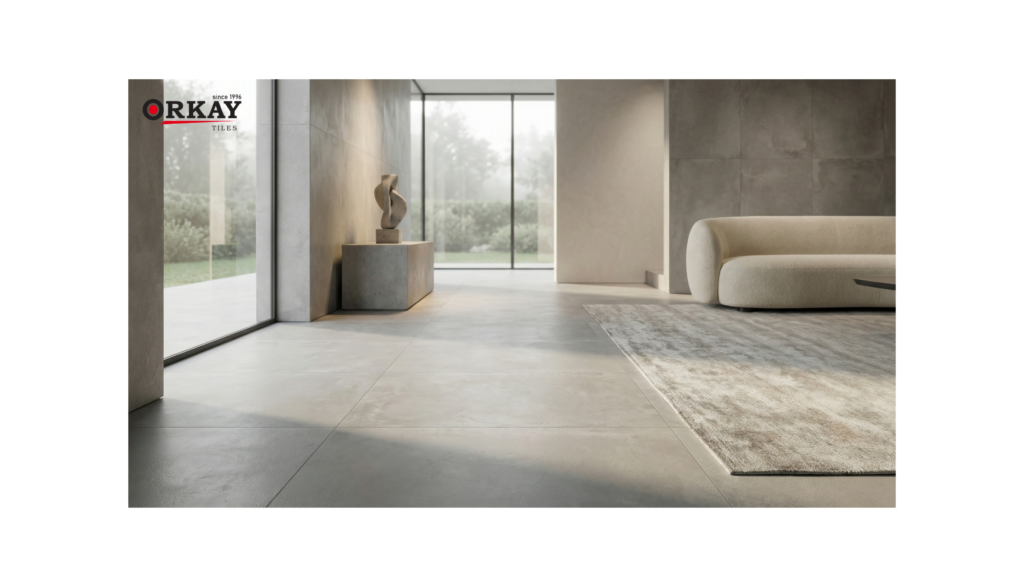
Practical Benefits of 1200×2400 mm Porcelain Slabs on Large Commercial Sites
From a project execution standpoint, 1200×2400 mm slabs offer several on-site advantages:
- Cleaner surface continuity across floors and walls
- Reduced visual breaks in large spans
- Suitable for feature walls, lobbies, corridors, and open areas
Modern porcelain slabs are engineered for dimensional stability, making them suitable for demanding commercial applications when installed using the right systems.
A New Standard in Commercial Architecture
As commercial spaces grow larger and design expectations rise, architects are looking for materials that deliver both visual impact and performance. Ultra-large-format slabs answer that need by combining scale, simplicity, and functionality.
For architects and developers working on premium commercial projects, slab selection is no longer just a design choice. It is a strategic decision that affects execution quality, maintenance efficiency, and long-term value.
This is why 1200×2400 mm porcelain slabs are fast becoming the preferred standard for modern commercial architecture.
Why Architects Specify 1200×2400 mm Porcelain Slabs
For architects and project consultants, 1200×2400 mm porcelain slabs offer a balance between design freedom and execution reliability. Their scale reduces visual breaks, while porcelain performance ensures durability in high-footfall commercial environments. This makes them suitable for projects where long-term performance and maintenance efficiency are critical.
Conclusion: Why 1200×2400 mm Porcelain Slabs Are the Future
As commercial spaces continue to grow in scale and complexity, material selection plays a critical role in both performance and visual impact. The increasing adoption of 1200×2400 mm porcelain slabs reflects a clear shift toward cleaner surfaces, minimal joints, and seamless architectural expression.
By significantly reducing grout lines, these large-format slabs help architects and developers achieve premium interiors while also addressing long-term maintenance and hygiene requirements. Their ability to cover expansive areas with fewer joints improves visual continuity and simplifies upkeep in high-traffic commercial environments.
For architects, consultants, and commercial developers, specifying 1200×2400 mm porcelain slabs is no longer just a design preference—it is a strategic decision that enhances execution quality, operational efficiency, and long-term asset value.
Frequently Asked Questions
Are 1200×2400 mm porcelain slabs suitable for high-traffic commercial areas?
Yes. These slabs are engineered for strength, durability, and dimensional stability, making them suitable for airports, malls, hotels, corporate offices, and other high-footfall commercial spaces.
Do 1200×2400 mm porcelain slabs reduce maintenance requirements?
They are commonly specified for commercial flooring, feature walls, lobbies, corridors, reception areas, and large wall cladding applications where seamless design is required.
Where are 1200×2400 mm porcelain slabs commonly used in commercial projects?
They are commonly specified for commercial flooring, feature walls, lobbies, corridors, reception areas, and large wall cladding applications where seamless design is required.